
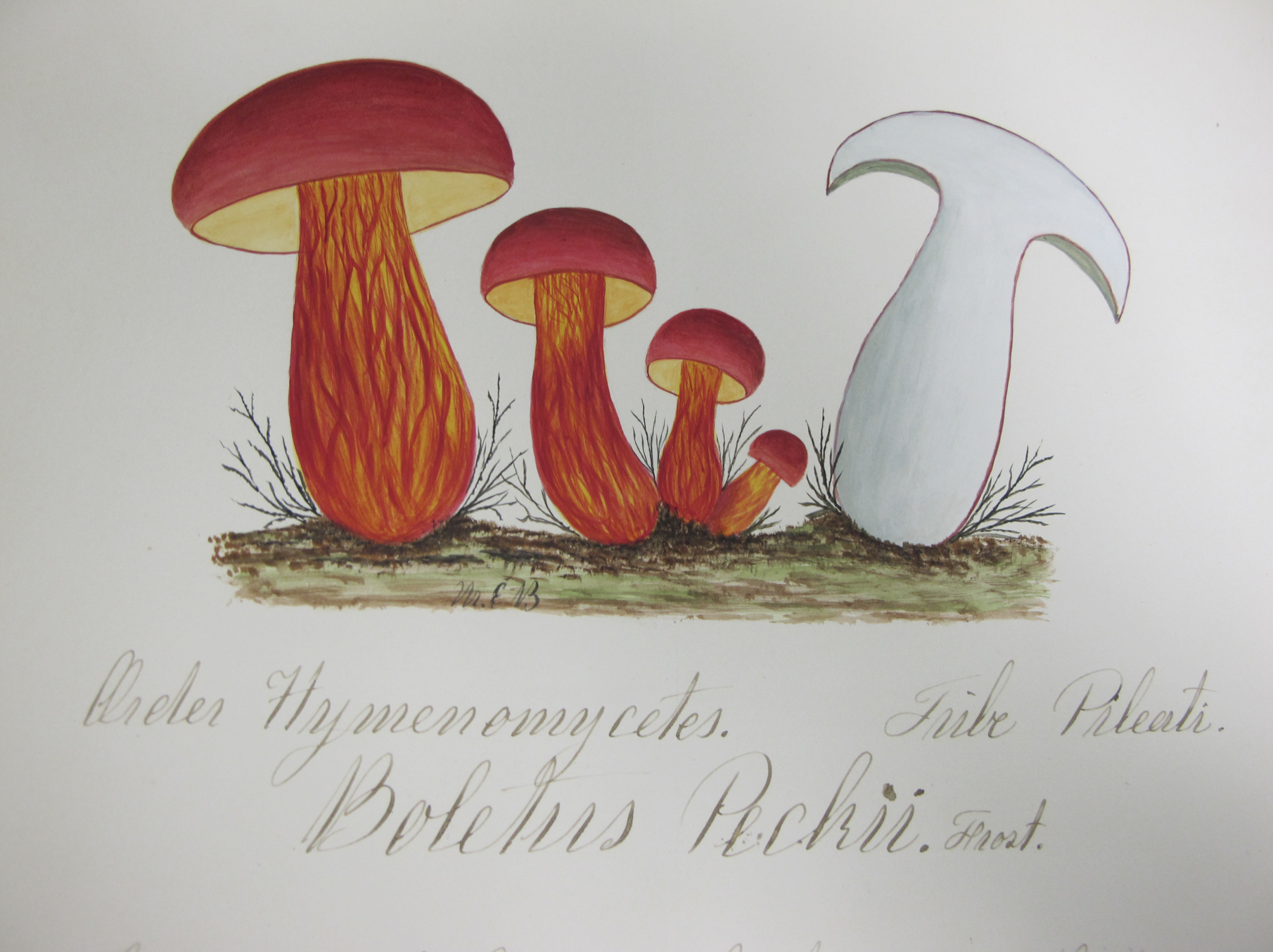
 This February, we celebrate the life of Mary Elizabeth Banning (1822–1903), a self-taught mycologist and botanical illustrator whose devotion to the often-overlooked kingdom of fungi echoes the Reserve’s own ethos: to honor all forms of life and the stories they tell.
Several prints of Mary’s illustrations are on display in the Residence through February.
Born on Maryland’s Eastern Shore in 1822 into a well-established family, Banning developed an early fascination with the natural world. Yet her path diverged from conventional science, not from lack of ability, but from the realities of her time. Without formal scientific training—particularly rare for women in the 19th century—she pursued mycology, the study of fungi, a field then emerging within botanical sciences. Fungi were largely dismissed by mainstream biology, often considered unattractive or insignificant. Banning saw them differently. To her, they were beautiful, complex organisms deserving closer attention.
Banning’s greatest achievement was her monumental work, The Fungi of Maryland. Between 1868 and 1888, she traveled Maryland’s woods, marshes, and fields, collecting specimens, examining them with her own microscope, and producing meticulous watercolor illustrations paired with thoughtful scientific descriptions. The result was 174 detailed paintings and notes that captured the subtle diversity of fungi in their natural contexts. Her manuscript was visionary: both a scientific record and a rich artistic tapestry bridging observation and wonder.
Banning’s talents did not go entirely unnoticed in her lifetime. She maintained a 30-year correspondence with Charles H. Peck, the preeminent mycologist and New York State Botanist, who published some of her species descriptions and served as a mentor. Over her lifetime, Banning formally described 23 fungal species new to science—a remarkable achievement for any scientist, much less one working independently in an era that offered few opportunities to women.
Despite her brilliance, Banning struggled with the constraints of her era. Financial pressures, caregiving responsibilities, and institutional exclusion deeply influenced her life and work. When she completed her manuscript in 1889, she entrusted it to Peck for safekeeping—but her hopes for publication were never realized in her lifetime. The manuscript lay hidden for almost a century before its rediscovery in the 1980s.
Today, Banning’s legacy is being reexamined and honored. Her watercolors have been exhibited widely, and her contributions recognized as foundational within early American mycology. In 1994, she was inducted into the Maryland Women’s Hall of Fame, and her work continues to inspire scientists, artists, and nature lovers alike.
–Written by Joseph Zapotosky
Sources:
New York State Museum: https://nysm.nysed.gov/exhibitions/outcasts-mary-bannings-world-of-mushrooms
New York Times: https://www.nytimes.com/2025/03/25/science/mushrooms-fungi-new-york-state-museum.html
Hyperallergenic: https://hyperallergic.com/mary-banning-woman-scientist-and-artist-who-revolutionized-the-study-of-mushrooms/
55+ life: https://55pluslife.com/new-york-state-museum-outcasts-exhibit-mushrooms-in-watercolors/
Cornell University Library: https://exhibits.library.cornell.edu/unturned-leaves/feature/mary-elizabeth-banning