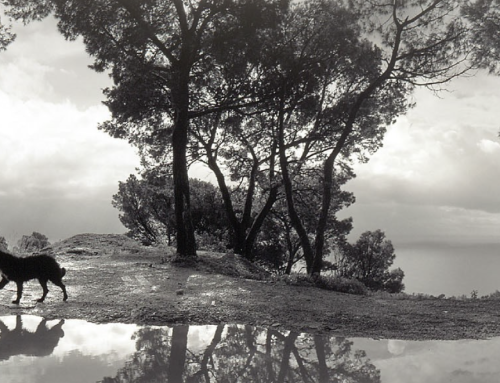

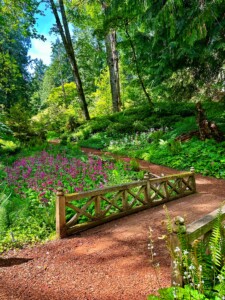
 Tucked within the Rhododendron Glen, the Christmas Pond has long been one of the garden’s quieter, more intimate spaces. Created in 1970 by Prentice Bloedel as a Christmas gift for his wife, Virginia, it was conceived as a water feature within a broader landscape devoted to reflection and connection with water.
For decades, the pond was actively maintained through periodic dredging to remove accumulated sediment. However, this approach is no longer feasible. The resulting shift in management has opened the possibility for a new landscape feature.
A Turning Point: Phytophthora ramorum and Adaptive Change
Bloedel Reserve has been actively managing Phytophthora ramorum since 2015, particularly within the Rhododendron Glen and Camellia Trail, where susceptible host species are concentrated and where positive detections have previously occurred. In 2021, the organization entered into a compliance agreement with the Washington State Department of Agriculture outlining Best Management Practices (BMPs) to reduce the risk of pathogen spread.
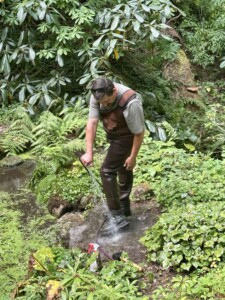
Andy Moss, Garden Manager, rinsing his shoes after being in the pond.
Although P. ramorum has not been detected on plants at Bloedel Reserve since February 2016, our management continues under the assumption that the pathogen may persist in the landscape. All elements of the disease triangle–susceptible hosts, favorable environmental conditions, and potential pathogen presence–remain in place. As a result, continued vigilance and adherence to BMPs are required to limit spread and contain the pathogen within known areas.
The Christmas Pond is now treated as a ramorum hot zone. Because dredging could mobilize the pathogen, sediment has been allowed to accumulate, transforming a routine maintenance practice into a biosecurity risk and prompting a shift away from the pond’s original form.
From Pond to Fen-Inspired Wetland
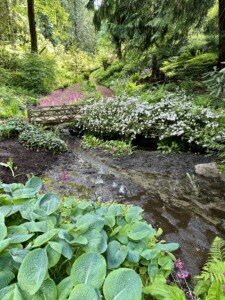
The pond has become shallower over time.
As sediment has accumulated over time, the pond has naturally become shallower. Rather than resisting this process, the site is being guided toward a fen-inspired wetland garden, with the surrounding area now referred to as the Christmas Garden, maintaining a connection to the site’s history.
While this feature is described as a fen, it is important to note that it is not a true fen in the strict ecological sense. True fens are naturally occurring, groundwater-fed wetlands that are typically nutrient-rich and often peat-forming. They are frequently dominated by grasses, sedges, and, in shaded conditions, ferns.
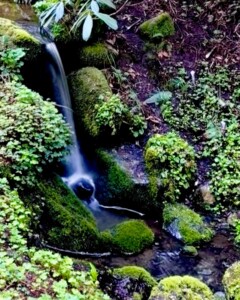
Christmas Garden Waterfall
This constructed wetland shares many characteristics with a fen, particularly its nutrient levels, plant communities, and relationship to moving water, but differs in that it is not peat-based. Instead, it is best understood as a fen-inspired system that mimics key conditions and functions of a natural fen.
Fens are often associated with slow-moving water systems, and this site loosely evokes a wooded oxbow or low-gradient wetland near the end of a stream system, just above a transition point such as a waterfall.
Designing the Transition
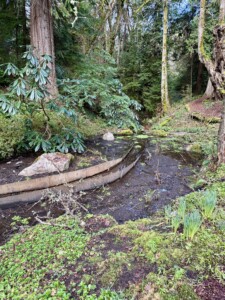 To support this transition, a temporary plywood-walled channel has been installed to divert water while new plant communities establish. Water continues to move through the system, but the site is now managed to function more like a wetland, with variable water levels that rise and recede over time and responds to seasonal and environmental conditions.
The planting strategy reflects an adaptive approach. A few species that are well suited to riparian conditions are currently under evaluation include Caltha palustris (marsh marigold), Sagittaria latifolia. (wapato), and Lobelia cardinalis ‘Queen Victoria’ (Queen Victoria cardinal flower).
The objective is not to fully predetermine outcomes, but to observe plant performance over time, identifying which species establish, persist, and shape the evolving character of the site. In this way, the landscape emerges through an ongoing interaction between design intent and ecological response.
Visitor Experience, Plant Collections, and Ecological Goals:
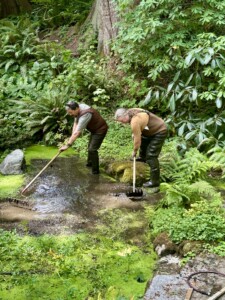
Andy Moss and Don McKinney hard at work on the Christmas Garden.
The emerging wetland feature expands the Reserve’s plant collections by creating conditions suitable for wetland and moisture-adapted species which are underrepresented in the gardens.
Ecologically, the project reflects a shift toward working with site conditions rather than against them. Sediment accumulation is treated as a generative process rather than a problem to be removed. Disturbance is minimized in a pathogen-sensitive area, and variable hydrology supports greater habitat diversity. The result is a landscape that responds directly to both ecological realities and operational constraints.
An Evolving Landscape
The Christmas Pond is not being removed; it is evolving. The constraint of sediment accumulation under pathogen management has become an opportunity to develop a more dynamic and adaptive landscape. The site is no longer defined by a fixed end state, but by an ongoing process of change. As with all living systems, its long-term character will not be fully designed in advance, but will emerge over time, shaped by water, plants, and continued observation.
–Written by Kaslin Daniels, Director of Horticulture & Design