
Scholar/Author/Naturalist: Barry Lopez and Bloedel Reserve
–Written by Jane Carlin, Archives Volunteer
From its beginnings, Bloedel Reserve has been committed to creating and maintaining a place where people can experience and appreciate the natural world. During the Reserve’s early decades, this commitment was reflected in the Virginia Merrill Bloedel Lecture Program, established to recognize individuals whose accomplishments had contributed to nature, humanity, science, or our understanding of the world. The program provided an opportunity for distinguished thinkers and writers to share their ideas with the Reserve community.
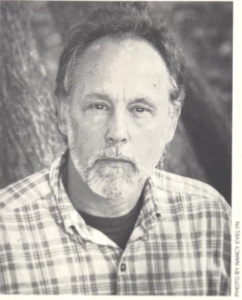 Among the notable speakers invited to the Reserve was the celebrated naturalist and author Barry Lopez (1945–2020), who delivered the Virginia Merrill Bloedel Lecture on September 11, 1998. His lecture, The Language of Animals, was a deeply personal and reflective exploration of our relationship with animals, the land, and the legacy we leave to the places we care for.
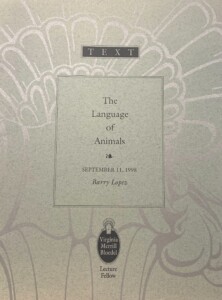
Lopez’s lecture was later published as a keepsake chapbook by the Arbor Fund. A copy is preserved among Bloedel Reserve’s historical materials, providing a tangible connection to this important moment in the Reserve’s history. The essay has also appeared in several anthologies, including Worldviews and the American West: The Life of the Place Itself, published by Utah State University Press, and A Place on Earth, published by the University of Nebraska Press.
A Writer Who Listened to the Natural World
Barry Lopez was a renowned essayist, author, and short-story writer who lived in Oregon. He received the National Book Award, a Guggenheim Fellowship, and numerous other honors. Throughout his career, Lopez traveled extensively and worked alongside natural scientists as a member of field teams. His writing was informed not only by scientific inquiry but also by philosophy, history, and the knowledge and traditions of Indigenous peoples.
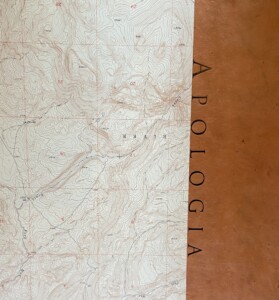 Lopez’s connection to the natural world is also represented in a remarkable artists’ book that he gifted to Bloedel Reserve. Apologia explores his deeply personal response to animals killed along the highway. During a 1989 cross-country drive from Oregon to Indiana, Lopez developed the habit of stopping to remove roadkill from the roadway. For him, this was an act of respect and mourning—a way of acknowledging the lives lost and confronting the human consequences of modern transportation.
Apologia reflects on human indifference, grief, and moral responsibility toward the natural world. Lopez contrasts the wonder and complexity of nature with the destruction caused by our modern landscape and asks how we might find meaning and responsibility in the face of ecological loss.
The book is an extraordinary example of the artists’ book as a vehicle for ideas and reflection. It features woodcuts by artist Robin Eschner and was published by Lone Goose Press, founded by bookbinder Sandy Tilcock in Eugene, Oregon.
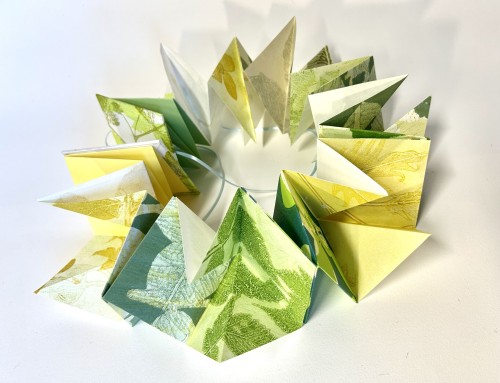
The structure of Apologia is an accordion binding housed in a custom clamshell box. Twenty-three original woodblock images are printed as a single, continuous foldout measuring approximately 22 feet in length, with Lopez’s text woven throughout. The edition was limited to 66 copies. Particularly striking is a physical tire-tread print made from ink applied to the tire of Lopez’s own Toyota 4Runner—the same vehicle he drove on his 1989 cross-country journey.
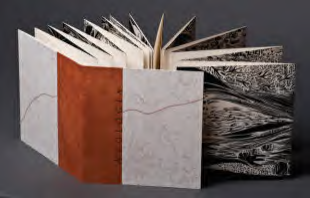
Apologia_Courtesy of Sandra Tilcock_Long Goose Press
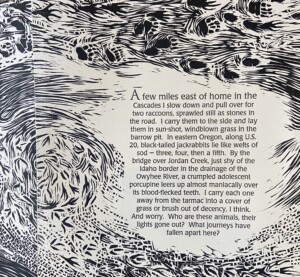
Inside page of Apologia
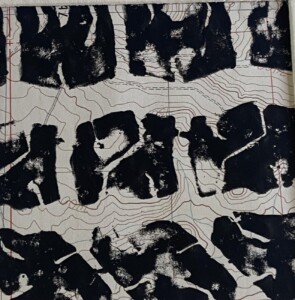
Barry’s tire tread
Listening to the Language of Animals
Today, as visitors walk the trails of Bloedel Reserve and encounter deer, birds, otters, beavers, and countless other forms of life, Lopez’s words remain remarkably relevant. His lecture reminds us that experiencing nature is not simply a matter of observing it, but of learning to listen and to recognize that we share the landscape with other living beings.
In The Language of Animals, Lopez wrote:
“To hear wild animals is not to leave the realm of the human; it’s to expand this realm to include voices other than our own. It’s a technique for the accomplishment of wisdom.”
These words offer a fitting reflection on the purpose of Bloedel Reserve. The Reserve is not only a place of beauty, but also a place that invites us to pay attention—to observe, listen, and consider our relationship with the living world around us.
Through both his lecture and Apologia, Barry Lopez left Bloedel Reserve with a lasting reminder: caring for nature begins with the willingness to see, hear, and acknowledge the lives with which we share the landscape.
Sources:
The Virginia Merrill Bloedel Lecture Chapbook located in the Bloedel Reserve Archives
The Barry Lopez Foundation for Art & Environment: https://barrylopezfoundation.org/
The Goal Has to be One to Listen: An interview with Barry Lopez: https://www.thegeorgiareview.com/posts/the-goal-now-has-to-be-to-listen-an-interview-with-barry-lopez/
Remembering Nature Writer Barry Lopez: https://www.npr.org/2021/01/08/954833226/remembering-nature-writer-barry-lopez