
A Legacy of Philanthropy
As a docent in the Residence, I am continually struck by visitors’ admiration for Prentice and Virginia Bloedel’s extraordinary generosity in establishing the Reserve for the public to enjoy. In these turbulent times, their example reminds us of the lasting impact individuals can have on their communities. That spirit of giving continues today through the generosity of those who support the Reserve.
The Bloedels’ commitment to philanthropy, however, began generations before the Reserve was established. While reviewing the Reserve’s historical papers, I discovered a remarkable document written by Prentice father, Julius Harold Bloedel (J.H. Bloedel), entitled My Creed. Although Julius was best known for building a successful lumber empire, his personal creed reveals a thoughtful man guided by principles that extended well beyond business.
His seven principles included being active, proud, tolerant, faithful, honest, grateful, and supportive of the founding principles of the American republic. One passage offers particular insight into his values: “Personal integrity is the mainspring of successful living and just as honesty is always the best policy, so integrity encompasses all in social as well as business relationships.”
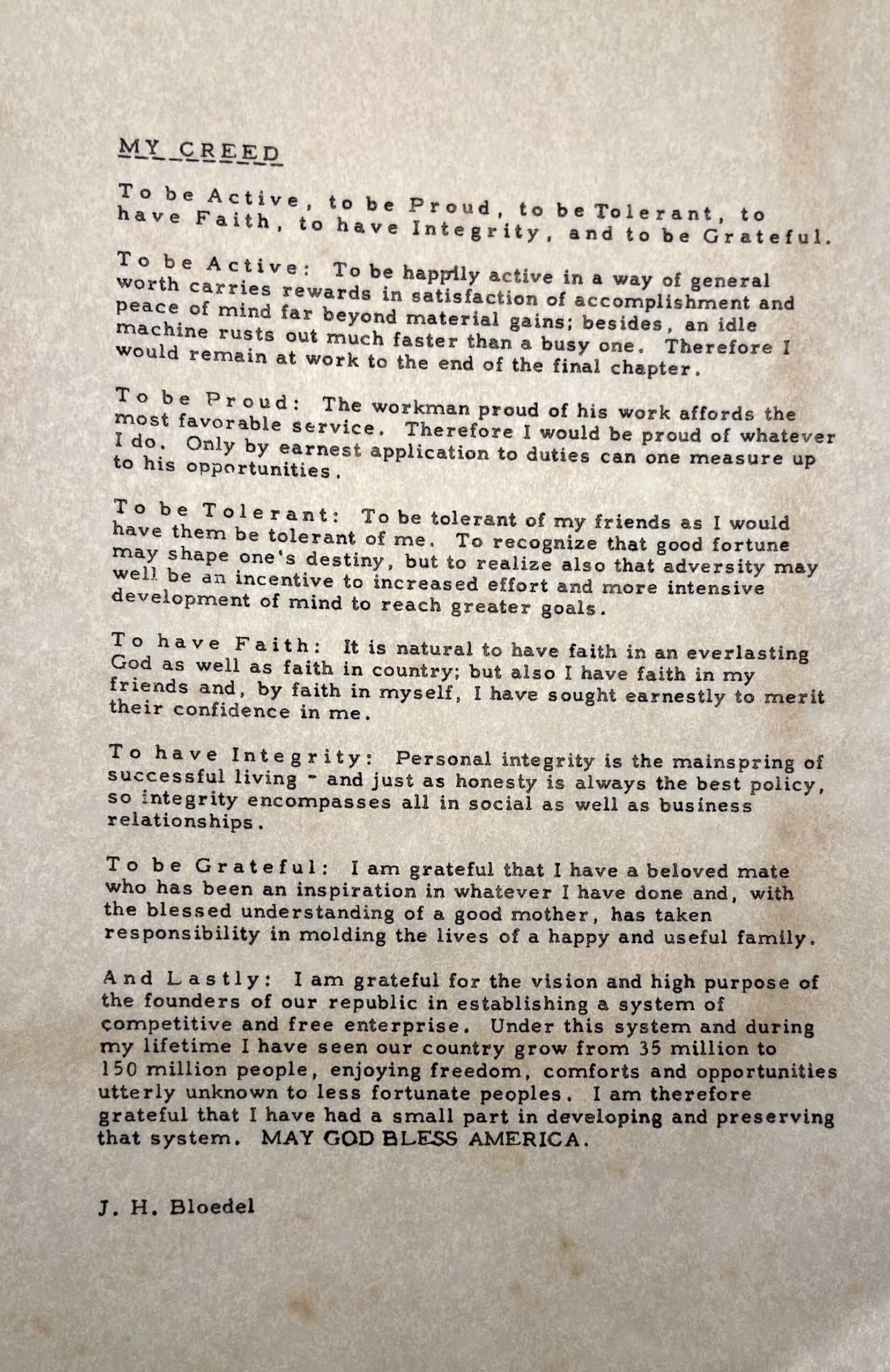
J.H. Bloedel’s creed
J.H. was a very successful businessman. In fact, in a newspaper article from March 2, 1950, his business acumen was traced to the start-up of a bicycle agency! This early photograph from 1885, taken in Sheboygan, Wisconsin, where he spent most of his youth, is in the Bloedel Historical Materials.
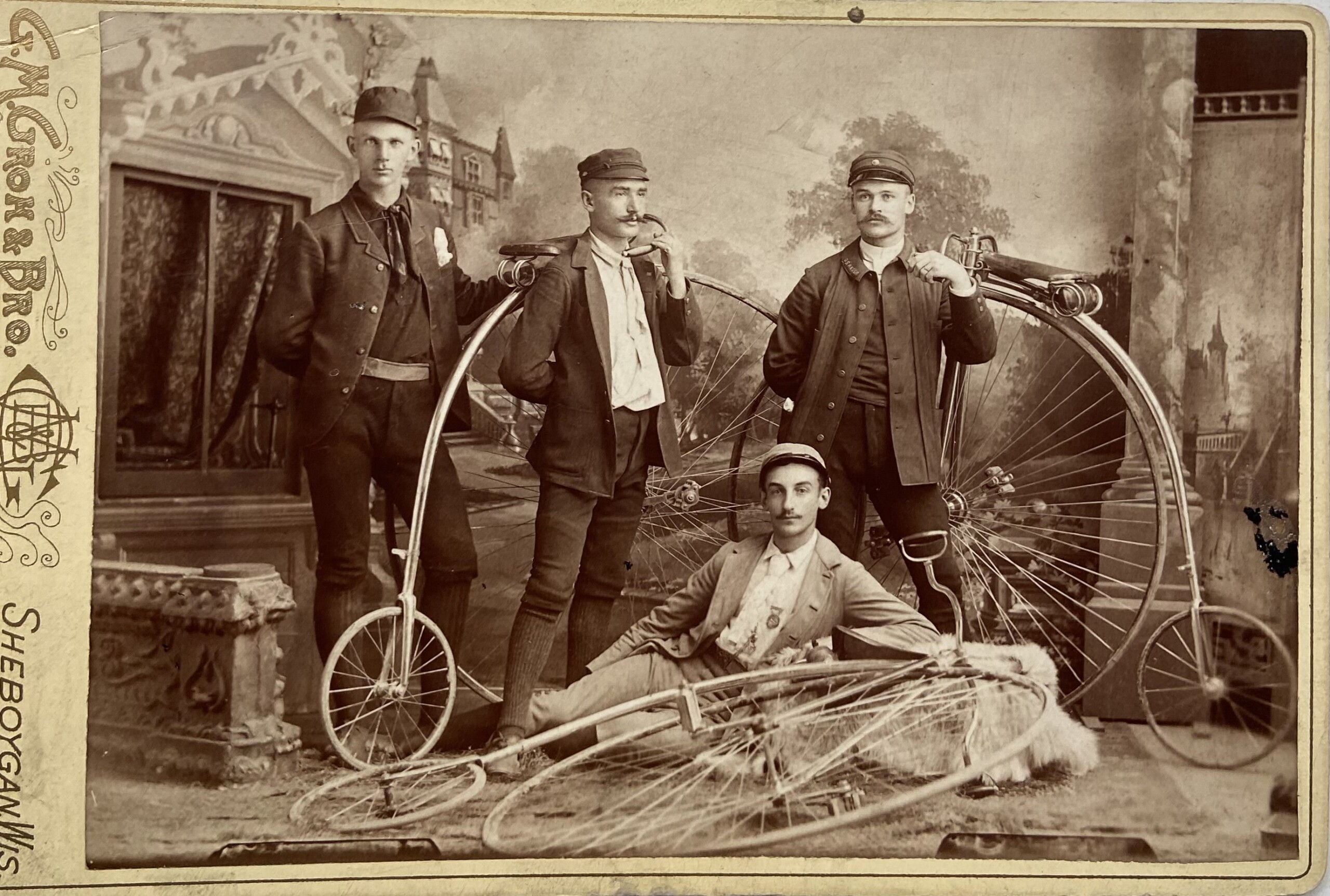
J.H. Bloedel in 1885
As his success grew, J.H. and his wife, Mina, put the principles of his Creed into practice through significant gifts to their community. In 1946, they donated 12 acres of waterfront property on Lake Whatcom, near Bellingham, along with $100,000, to establish a public park and bathing beach. Julius also supported forestry education at the University of Washington, where Bloedel Hall bears his name. Following the couple’s deaths, their family established Bloedel Hall at Saint Mark’s Cathedral in Seattle in their memory.
This tradition of giving continued with their son, Prentice, and his wife, Virginia.
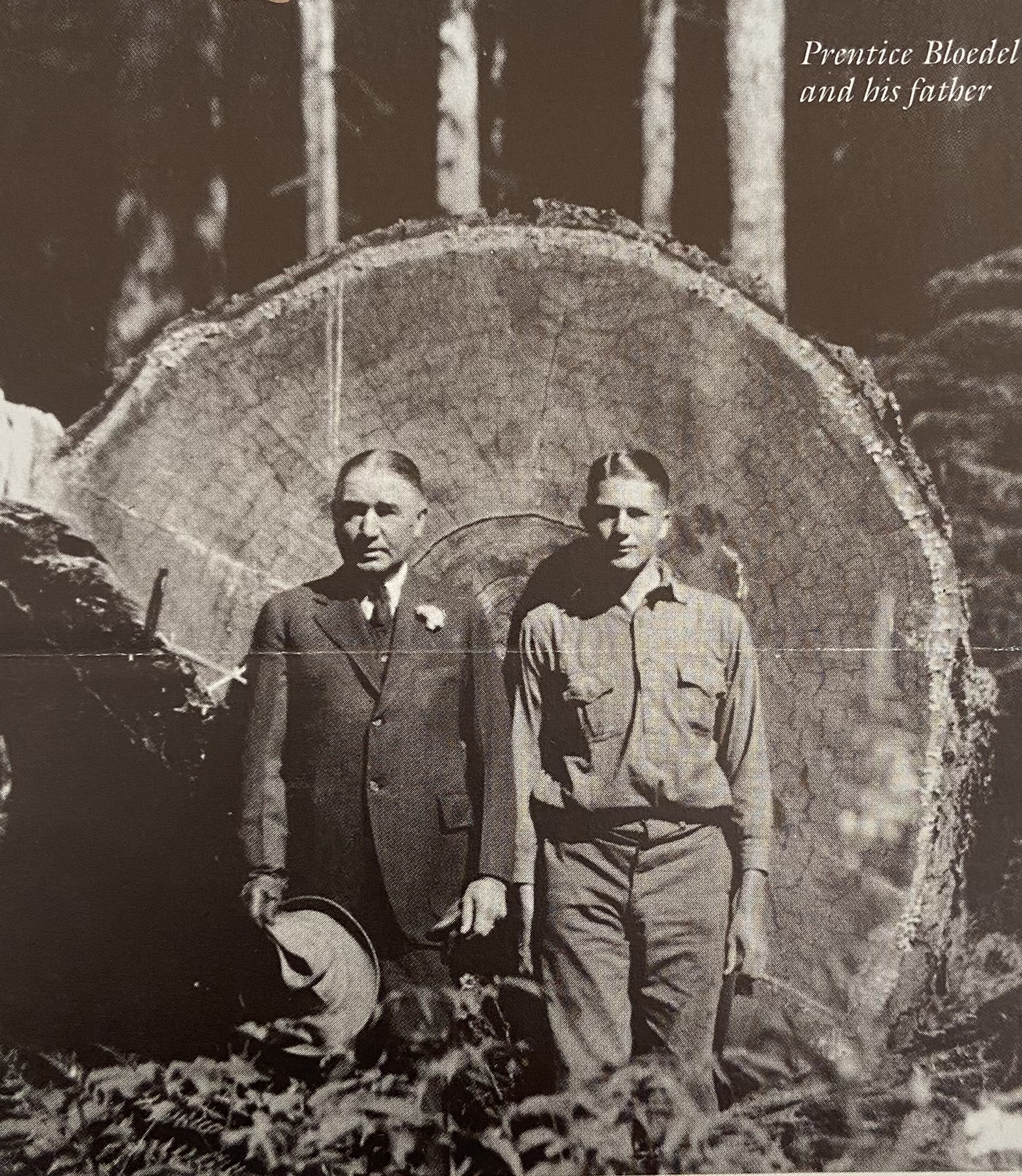
Prentice Bloedel and his father.
Long before they opened their property to the public as the Bloedel Reserve, they supported institutions and cultural initiatives throughout the Pacific Northwest. The Bloedel Foundation contributed $1.25 million toward Vancouver’s Bloedel Conservatory, Dancing Fountains, and surrounding plaza—a landmark gift for the city at the time.
Their generosity also reached Seattle, where they supported the University of Washington’s Japanese Garden, the Virginia Merrill Bloedel Hearing Research Center, Seattle Children’s Hospital, and the Seattle Art Museum. Their daughter, Virginia Bloedel Wright, carried this commitment forward with her husband, Bagley Wright. A longtime Seattle Art Museum trustee and a leading patron of public art, she helped shape the region’s cultural landscape through the establishment of the Virginia Wright Fund, which supported public art across the Pacific Northwest.
Their other daughter, Eulalie Bloedel Schneider, continued the family tradition through her support of the arts, education, and opportunities for young people. She established the Eulalie Bloedel Schneider Foundation to support community programs, including job training and educational opportunities for young people and women. She also supported Seattle’s performing arts, establishing an endowed fund for artistic excellence at Seattle Opera.
The family’s commitment to art, culture, and the natural world extended beyond the Pacific Northwest. Prentice’s brother, Lawrence H. Bloedel, began his career as a librarian at Williams College in Massachusetts and became an avid collector of American art. In 1960, he and his wife, Eleanor, established the Greylock Foundation to support cultural institutions. Following his death, significant portions of their extensive art collection went to the Williams College Museum of Art and the Whitney Museum of American Art. Their former property, Field Farm, is now a public nature sanctuary managed by The Trustees of Reservations.
Another branch of the family shared this devotion to gardens. Virginia’s sister, Eulalie Merrill Wagner, worked with landscape architect Thomas Church, who also helped shape the Bloedel Reserve, to design Lakewold Gardens in Tacoma. She helped open the garden to the public in 1989, believing that gardens would become increasingly precious as people spent more of their lives in urban environments. As she observed, gardens remind us “that we began in the garden.”
It is fascinating to consider how these family members may have shared their ideas about gardens, art, education, and public service. Although their individual interests differed, they shared a belief that personal success carries an opportunity—and perhaps a responsibility—to give something back.
Julius and Mina Bloedel helped establish a legacy that flourished through their children and grandchildren. Bloedel Reserve is one of its most enduring expressions: a gift of beauty, reflection, and connection with the natural world, preserved for generations to come. Their example continues to inspire us, reminding us that philanthropy is not simply about the size of a gift, but about the lasting difference it makes in the lives of others.
For additional information, you may wish to consult:
https://lakewoldgardens.org/
https://archivesspace.williams.edu/repositories/2/archival_objects/84453
https://obituaries.seattletimes.com/obituary/eulalie-schneider-1093815139
https://window.wwu.edu/artistic-gifts
https://thetrustees.org