
When the World Reveals Itself Again: A Researcher’s Year of Walking (and Walking With) at Bloedel Reserve
Guest post by Hongfei (Fei) Li, PhD Candidate, College of Built Environments, University of Washington as part of her dissertation fieldwork
One clear morning this April, I was walking about fifteen paces behind my study participant near the bird marsh. The pond was still and dark, reflecting dormant tree branches. It was very quiet, the kind of quiet created by sounds. The person ahead of me slowed, then stopped. I stopped too. The birds were active. They were everywhere in the early morning light, calls close and far, layered over one another, as background and highlight, like a symphony the pond had arranged for itself. Standing still within the ever-changing sound, I felt the moment was as clear as the reflections in the pond. And I remember thinking: through countless walks in this place, I have given myself over to this land, and it keeps giving back. It rescues me from sitting at my screen indoors, pulls me away from the endless trivia of navigating academic life as an international student, and lures me to take a three-hour public transit ride from the dense urban core, across a stretch of sea, to this island. To have a moment so deeply engaged with nature, and with my participants. To perceive the world anew through my own body, while gaining a bit of the world as perceived through each of my participants’ bodies. To accompany a moment seen through a different pair of eyes, gazing deeply into the trees, moss, pond, birds, and moving through the mesmerizing intervals between sunlight and shade through canopies. To witness a moment of embodied presence, a joy of being here with living systems, a blast of identifying a rare bird, a gentle touch upon a new bloom, a happy spin in a forest clearing, a deep breath within a pleasant pause, tears from being moved, nostalgia for a fond memory, a remembering of a past bittersweet story, and simply, the lightness and realness of just being here and now. Because of these moments, I often find myself moved. Moments like these convince me this kind of fieldwork cannot be reduced to data and measurement, and should not be.
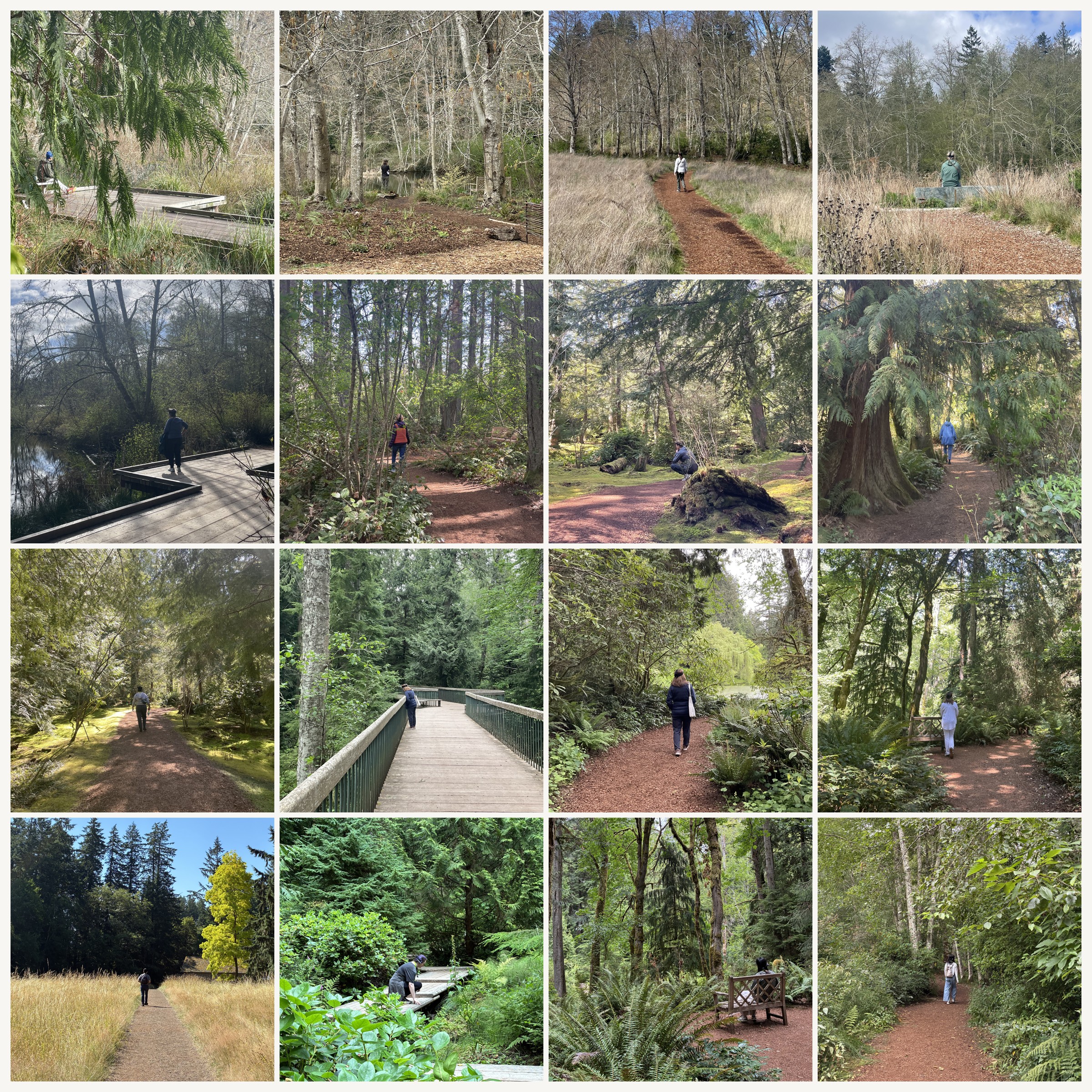
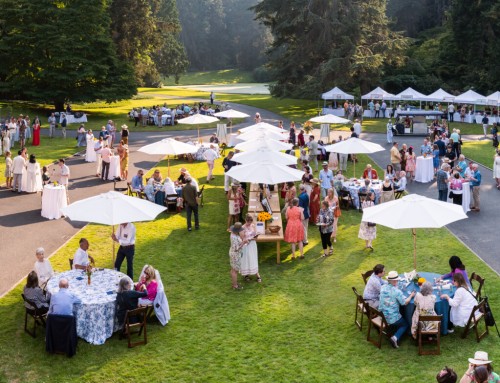
Study participants during their walks.
Being Right Here, Right Now
Here is something I have come to believe after a few years of working on my dissertation and walking in many landscapes: most of the time, we are not really where we are.
This isn’t a failing. It’s just how perception works. Think of walking a familiar route home: you arrive without remembering most of the environment you passed. Or the well-made door of your house: you never notice it, because it works seamlessly. Our bodies are extraordinarily good at handling the world quietly in the background, and our minds can be somewhere else. Philosophers have long discussed these different modes of absence: the body “disappears” and the “world” recedes into the background when we are “functioning well.” It’s efficient, and it’s most of life.
But there are moments when this mode of engagement changes. The world stops being a backdrop and becomes vivid, textured, much more real, and here. You feel the temperature of the air on your face and the give of the ground under your foot. The light has weight. Something in the landscape catches you before you’ve decided to look at it. In these moments the world starts to reveal itself again to us; sometimes, we may feel a part of ourselves revealed to us as well.
Mindfulness usually turns attention inward, making the body something you observe. What I’m curious about are those moments when you’re turned fully toward the world, and it’s through the body that you gain such direct contact with the world right in front of you. My question is whether places can invite this. Whether a curve in a path, a threshold between forest and clearing, a framed glimpse of water can do intuitively for a person, through embodied attunement. It works at a level that’s more ancient than language.
Walking, and Walking With
Volunteers took a slow, self-paced walk of thirty to forty minutes through the gardens, wearing a small, lightweight head-mounted camera that recorded the forward view. I followed at a distance, noting pauses, changes in pace, a head lifting toward the canopy. Before and after the walk, participants completed a short questionnaire drawn from the Presence Scale developed by Prof. Peter Kahn and colleagues at HINTS Lab, which involves a set of statements about stillness of mind, present-moment awareness, and the sense of one’s awareness extending outward.
Then we sat down together and talked about the walking experience. The method is called the micro-phenomenological interview, and it unpacks a singular, lived experience. Instead of asking “how was your walk,” I asked people to return to a moment, for example, thirty seconds beside the Reflection Pool, and describe it from their own first-person perspective. What was the very first thing you noticed? What was happening just before? Where was your body? Did something shift, and how did you know? People were often surprised by how much was in there beyond a summary of “peaceful.”
Before each session, I never knew who was about to show me the Reserve. Every walk was like opening a gift I couldn’t predict. Three sessions in a day meant three unique ways of being with the world. One person was drawn to the moss at their feet; another tracked a single bird from tree to tree; another stood at the edge of the meadow and simply breathed. One person, one walk, one conversation, one day, this moment, this place. Perhaps that is where the meaning of fieldwork and phenomenological research lies. Sometimes, after a few sessions, I felt all the experiences loaded onto me. They arrived as pulses; their feelings intertwined and merged through my body, and I was just a vessel trying to find a way to describe the interaction.
And through my own walking, too: the Reserve goes on revealing itself to anyone who keeps coming back. I’ve now walked these grounds across the seasons. Spring is crisp and sharp and quietly powerful, all things waking up, a force you can feel emerging from the ground. Then you see the light green tips on every branch, and the magnolia petals rushing out on the magnificent tree; it reminds you of the things that are worth waiting for. Summer is expansive and lush: color on the water, deep shadow, high flowing grass and a palette of blooms in the meadow, the elegant willow claiming its pleasant shade upon the lawn, with its soft branches floating on a light breeze, blue sky opening toward the Sound; it shows you the abundance of life. Fall carries a beautiful sorrow in the falling leaves of the Japanese maples, and the dappled light on moss and the dry garden gives you a sense of wabi-sabi, that transient feeling of beauty weathering with time. And winter is silence and solemnity: the evergreens standing firm, dark earth, bare branches, sometimes with snow damping the sound even further; it allows you to stay still. To return again and again is to experience many gardens within one, unfolding with time.
There is also something that feels, to me, like a strange coincidence. Years ago, before I ever came to Seattle, I read Elizabeth Meyer’s essay “Seized by Sublime Sentiments,” on Bloedel Reserve, in a landscape theory class, and thought: I want to experience that place in person. When I finally visited with friends in 2019, I was stunned. I could not have imagined that years later I would be doing my doctoral research here; or that I would one day read letters from the Bloedel family themselves, writing about nature and healing in words that echo what my participants tell me now, seventy years on.
To everyone at Bloedel who welcomed this project, and to every volunteer who shared their presence, thank you for the good company. I came to realize that there are more people than I knew who look at the world this gently, who feel the abundance and generosity of life in a tree, who are moved by the call of a bird enough to feel connected to the wildness. Spending my days among them, I felt less alone.
An Invitation, and an Ask
The fieldwork is finished now. The formal findings will make their way into academic journals in time. But one thing doesn’t need to wait for analysis, and I’d like to offer it here.
The next time you come, consider treating the walk as a walking meditation. Give yourself an hour and think of it as a gap in your life, a time outside of time. Let the phone stay in your pocket. The urge to capture a moment is very often what ends it. Set down whatever you carried in with you. Try to engage with the garden a little deeper: slower walk, more pauses, sitting down, bending over, looking into, attending, touching, smelling, looking for other species; those actions may unlock a moment when the world starts to reveal itself. The research also draws on work on human–nature interaction patterns, which refers to the idea that our encounters with the natural world fall into recurring forms shaped by evolution and culture: walking along a water’s edge, smelling a flower, sitting under a tree, encountering a more-than-human presence. These patterns are not just sentimental. They’re structural, shaped by the development of our perceptual systems, and they can be intentionally designed for. You can take up these invitations.
And if I could ask one thing: consider whispering. Conversation is one of the loveliest reasons to walk together. But sound carries here more than people realize, and a raised voice can end someone else’s most intimate moment with the natural world. When it’s quiet, many other sounds in nature emerge. Let that moment carry you into a deeper engagement with the world.
Further reading:
Li, H., & Kahn, P. H., Jr. (2025). Human–nature interaction pattern design in landscape architecture. Land, 14(10), Article 2051. https://doi.org/10.3390/land14102051
Kahn, P. H., Jr., Sabine, S., Gray, C. E., et al. (2026). The Presence Scale: A measure of optimal conscious awareness and being without thought. Journal of Happiness Studies, 27, Article 47. https://doi.org/10.1007/s10902-026-01026-2
Meyer, E. K. (1998). Seized by sublime sentiments: Between terra firma and terra incognita. In W. S. Saunders (Ed.), Richard Haag: Bloedel Reserve and Gas Works Park (pp. 5–28). Princeton Architectural Press.
With thanks to my dissertation committee: Lynne Manzo, Alex Anderson, Peter Kahn, and Philip Thurtle.