
Six Mosses to Know in the Moss Garden
Many plants are iconic to the Pacific Northwest, at least in the minds of those who live here. Locally around western Washington, Sword Fern, Salal, and Western Hemlock are well known and are well represented here at Bloedel Reserve. In eastern Washington we recognize Ponderosa Pine and Sagebrush. Those of you transplanted to Washington may recognize other hallmark plants from your point of origin. Such plants are facets of the places we know as “home”.
One group of plants we all recognize though is mosses; the green, cushiony carpets of our forests and the drapery on our trees. They occur not only in wetter areas but in almost all terrestrial environments. In eastern Washington where I grew up, there is moss out in the hot sand, hidden under the sparse shade of Sagebrush, dormant in the blazing summer to awaken with the autumn rains. Even the ice free areas of Antarctica sport mosses. Incidentally, one of those mosses, Ceratodon purpureus, is the same species you and I clean off our roofs. Even if we do not know what species they are, we do know they are mosses.
After seeing a moss, greater than 99% of us will have no idea what species of moss we are looking at. They are one of those cryptic plant groups that are daunting even for many botanists to identify, joining the ranks of grasses, sedges, and willows. But, as any botanist will tell you, learning to identify the more difficult plant groups is not impossible. It just takes patience…sometimes a lot of patience. And, perhaps a little magnification in the form of a 10x or stronger hand lens. Learning a few of the easier mosses is a good place to start.
The next time you visit the moss garden at Bloedel Reserve, look for these six mosses listed below, they are among the easier mosses to identify. Treat it as a kind of botanical treasure hunt!
Bent Leaf Moss
Rhytidiadelphus squarrosus
Family Hylocomiaceae
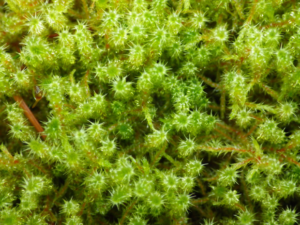
Bent-leaf Moss
This moss is quite possibly the easiest moss in our area to identify and many of you probably have it in your yards at home. Most of the ground moss along the paved road in front of the Moss Garden is Bent Leaf Moss. This species gets its common name because each leaf is “bent” 45 degrees downward, which is a useful recognition clue.
What to look for:
- Grows on the ground, especially in yards and disturbed areas.
- Likely to be found in the sunnier parts of your garden than in full shade.
- Light green to yellowish-green color.
- When viewed from above, its vertical growing stems look like stars.

Bent Leaf Moss habitat
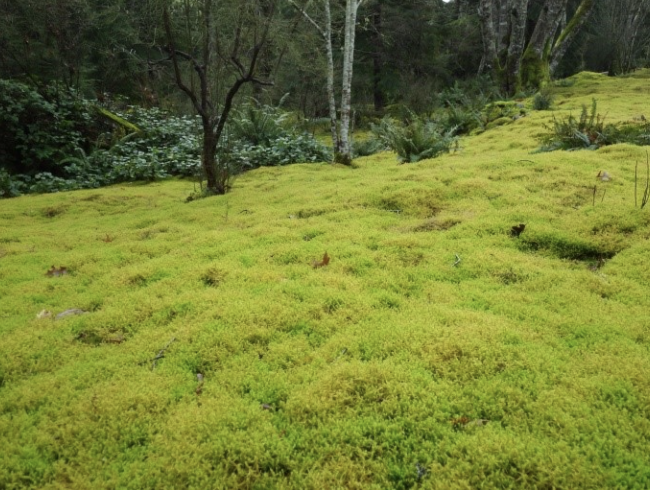
Large patch of Bent Leaf Moss in the NW corner of the Moss Garden.
Menzies’ Tree Moss
Leucolepis acanthoneuron
Family Mniaceae
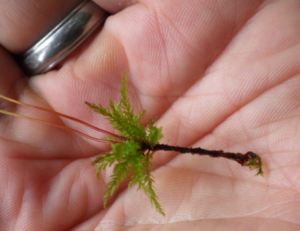
Menzies’ Tree Moss
Oh, this is a tree moss? It must grow on trees, right? Nope. It is called a tree moss for a reason, but you need to get on your hands and knees to see why. Look for it on the ground. When you think you’ve found a patch of it, push the individual plantlets apart to see them better. If you’ve found Menzies’ Tree Moss, each plantlet will look like a miniature tree. For the majority of mosses in our region, this habit is unusual. Only Climacium dendroides, simply called “Tree Moss” has a similar habit, but that is so far unknown at Bloedel Reserve.
What to look for:
- Grows on the ground in shadier spots than Bent Leaf Moss.
- Light green color.
- Tree-like growth habit of individual plantlets where the main stem branches heavily near the top.
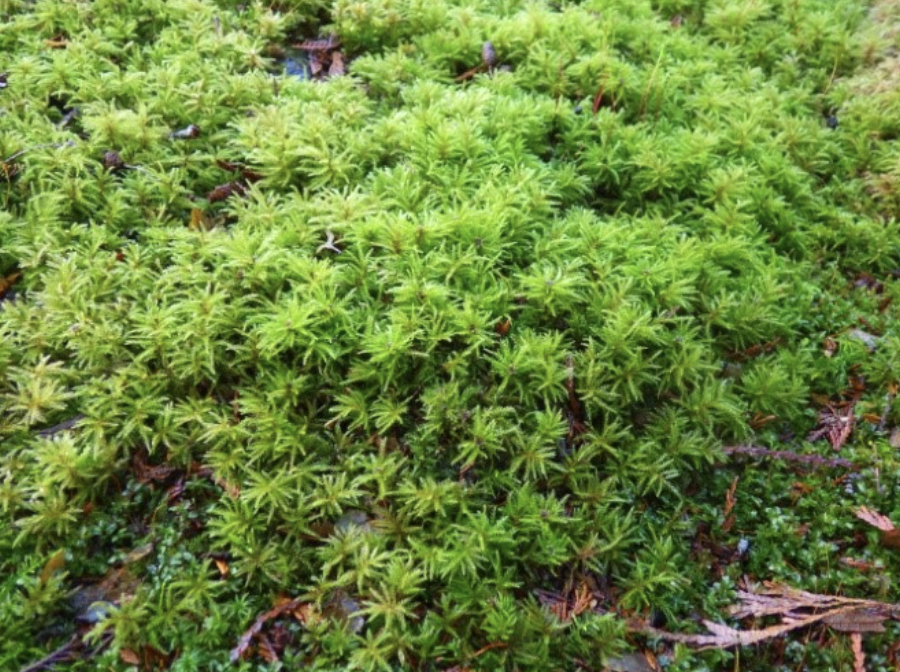
A patch of Menzies’ Tree Moss.
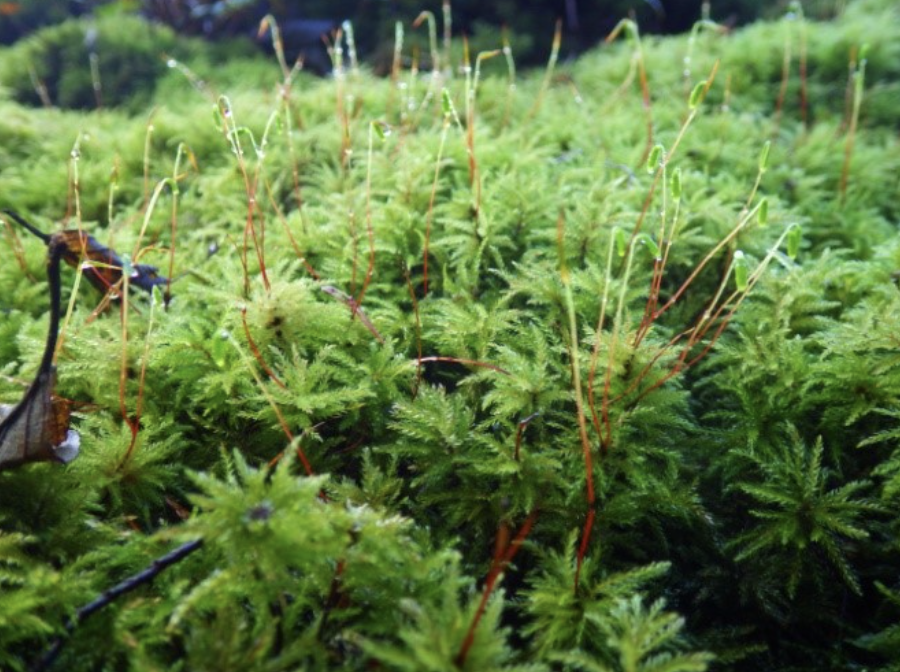
Close up of a Menzies’ Tree Moss patch. The “whiskers” are immature sporophytes (spore producing structures). They are not always present.
Juniper Haircap Moss
Polytrichum juniperinum
Family Polytrichaceae
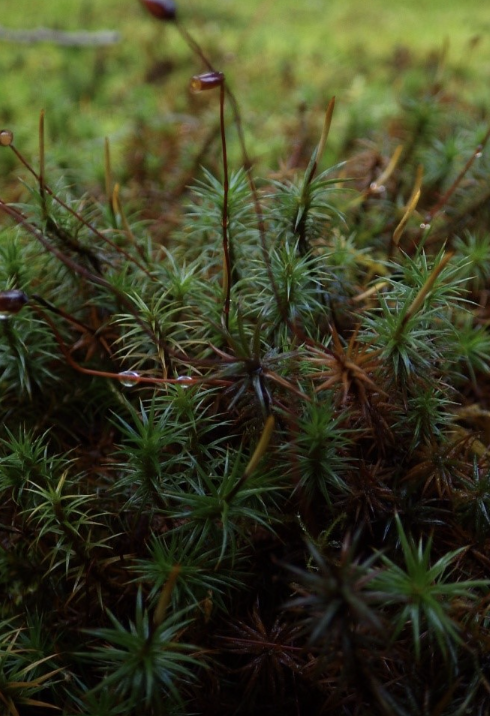
Juniper Haircap Moss
If you’ve ever taken a botany or biology class and learned even a little about mosses, you’ve probably seen pictures or even specimens of this moss. Moss life cycle diagrams frequently depict this species and probably for good reason: this species grows on every continent, even Antarctica.
There are several look-alikes for this moss. Some are other species of Polytrichum, others are related species of Pogonatum and Polytrichastrum. Polytrichastrum formosum is also in the Moss Garden but can be distinguished from Juniper Haircap Moss by its lack of reddish-brown awns at the ends of its leaves.
What to look for:
- Bluish-green, unbranched, upright plants.
- Each leaf ends in a red-brown awn (a narrow, bristle point). This can usually be seen with the naked eye, but magnification is helpful.

Note the reddish-brown awns on the leaf tips of Juniper Haircap Moss.
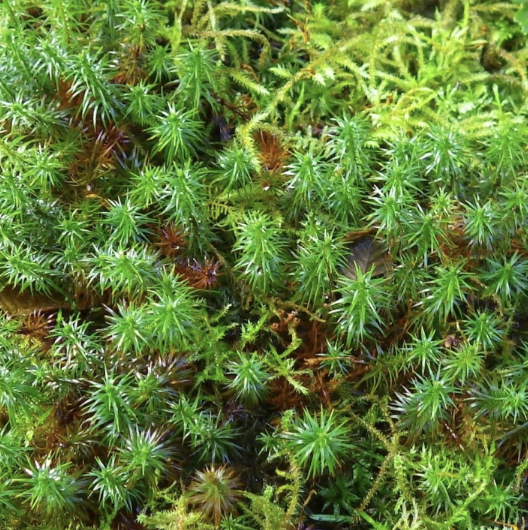
Juniper Haircap Moss patch.
Lanky Moss
Rhytidiadelphus loreus
Family Hylocomiaceae
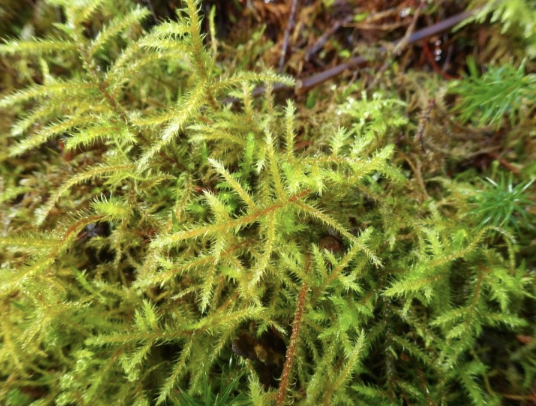
Lanky Moss
If you pay much attention to the scientific names here, you’ll notice that this moss belongs to the same genus as Bent Leaf Moss listed above. They are related and somewhat similar. Both occur commonly on the ground though Lanky Moss will sometimes be seen on logs or stumps more often. Both are also often dominant ground covers and tolerate some sun well, but Lanky Moss seems to tolerate shade better than Bent Leaf Moss.
A third species of Rhytidiadelphus¸ R. triquetrus (Goose-necked Moss), is in the Moss Garden too. It is distinct from its two sister species but is much less common.
What to look for:
- Yellowish green, usually with reddish color in the stems.
- Lacks the “starry” look of its sister, Bent Leaf Moss.
- Irregularly branched.
- Leaves of the main stem spreading, not pressed against the stem as in the look-alike Spear Moss.
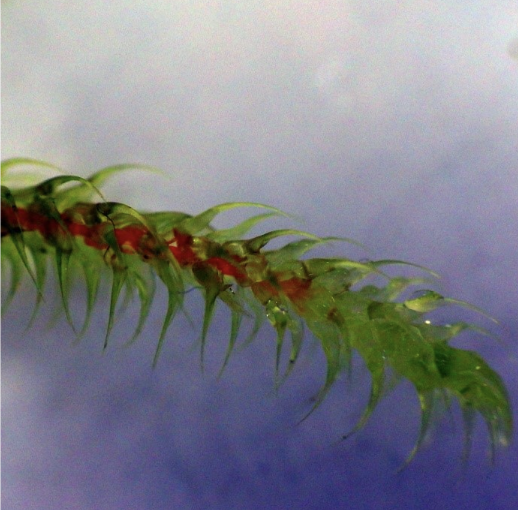
Close up of Lanky Moss stem, showing spreading leaves.
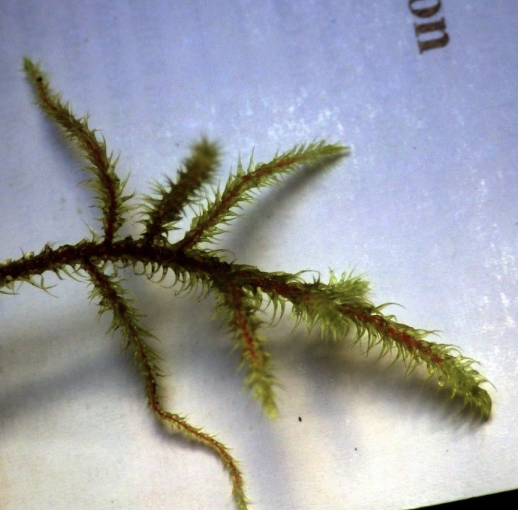
Lanky Moss stem. Note the irregular branching habit.
Dicranum
Dicranum sp.
Family Dicranaceae
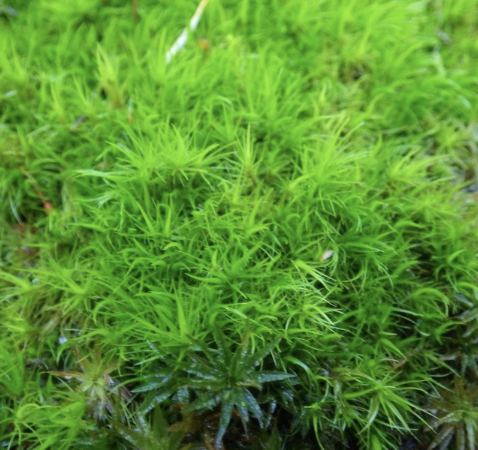
Dicranum Moss
I am not sure exactly which species of Dicranum is growing in our moss garden…possibly there is more than one residing species. There are about 20 species in the Pacific Northwest, and they can be difficult to tell apart, but I wanted to include it here simply because it stands in the Moss Garden enough to attract the attention of the occasional moss hunter.
What to look for:
- Bright green leaves. Much brighter than the surrounding species such that this moss really stands out visually.
- The leaves are curved to one side. This trait is not unique to Dicranum, but if you find curved leaves on bright green moss, you’ve probably found the Dicranum in the Moss Garden.
- Forms smallish clumps on logs or humus. This species occasionally forms large, dominant mats in the Moss Garden.
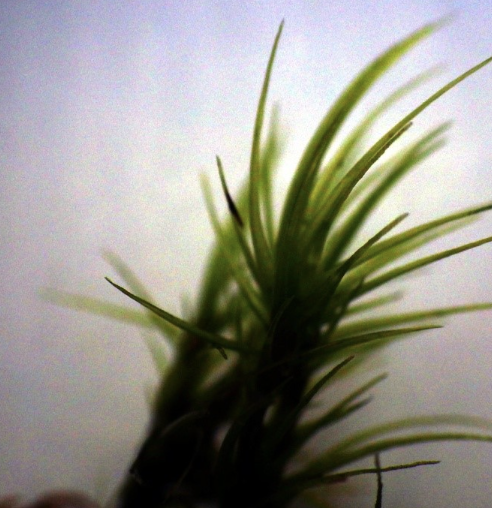
Close up of Dicranum showing curved leaves.
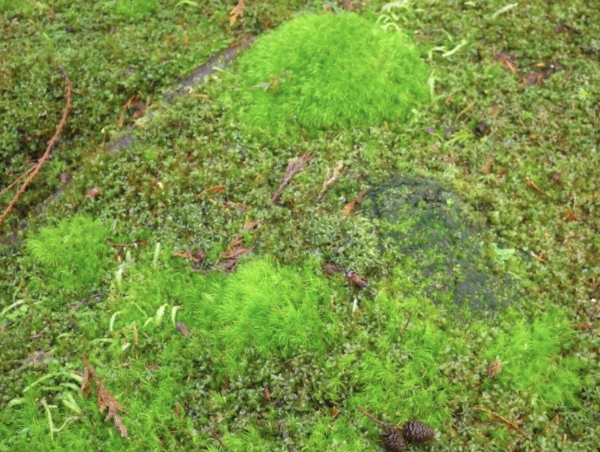
The Dicranum in the Moss Garden is noticeable by its bright green color against the darker or more yellowish mosses.
Spear Moss
Calliergonella cuspidata
Family Amblystegiaceae
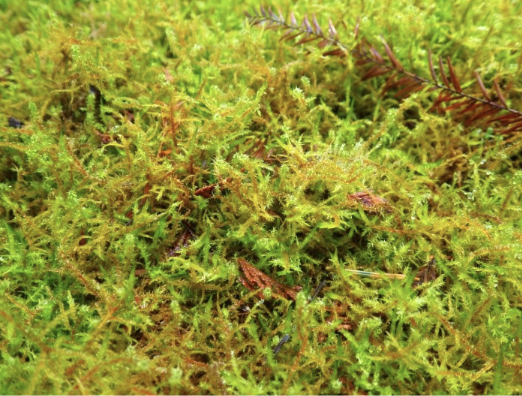
Spear Moss. Note the yellowish color. The main stems can have a reddish color to them like Lanky Moss.
Spear Moss resembles Lanky Moss and the two can be hard to tell apart. To make things worse, they both grow in similar habitats (on the ground, often in yards, although Lanky Moss is more common in natural habitats). In some spots of the Moss Garden, they can even be found growing intermixed. Despite the similarities though, they can be distinguished if you know what to look for.
What to look for:
- Growing on the ground or less commonly on stumps or logs.
- Leaves pressed close to the reddish main stem, not spreading. Leaves on the lateral stems (usually not reddish) tend to spread more. This differs from Lanky Moss that has spreading leaves on the main stem.
- The main stem has a spear-like appearance (hence the common name). To see this, look at the pictures below and imagine the main, reddish stems without their lateral branches. The growing tip of the main stem appears as the spearhead, so to speak.
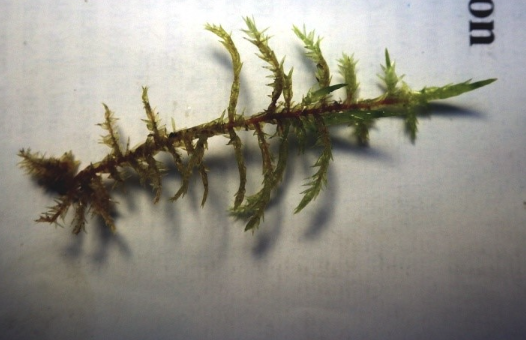
Overall habit of a Spear Moss stem.
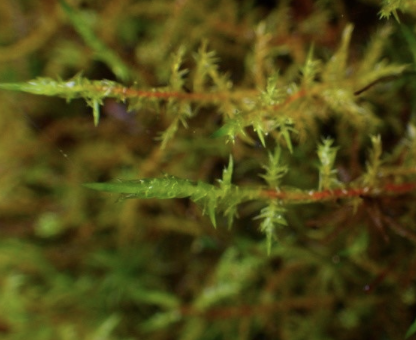
Two Spear Moss stems.
What Next?
Print out this article, grab your magnifier, take it with you to the Moss Garden at Bloedel Reserve, and look for these mosses. When you think you’ve found one, spend some time looking at it. Develop a mental image. You may find that remembering what a moss species looks like is not so much about special features and habits, but rather about textures and color shades and that is how you will remember the moss the next time you encounter it. Not that you shouldn’t learn the features that distinguish the species; they help you learn them to begin with. Doing this, you will also learn that studying mosses takes patience and often that is more important than a magnifier.
If you think you want to continue learning mosses, there are three books I’d recommend:
- Kimmerer, Robin W. 2003. Gathering Moss: A Natural and Cultural History of Mosses. Oregon State University Press.
- Pojar, J. and A. MacKinnon. 1994. Plants of the Pacific Northwest Coast. Lone Pine Publishing.
- Vitt, D.H., et al. 1988. Mosses, Lichens, and Ferns of Northwest North America. Lone Pine Publishing.
The last two books are for identification. The book by Pojar and Mackinnon is especially good, not just for learning mosses, but other local native plants as well. The first book is an outstanding introduction to the world of mosses written for everyone to read regardless of level of familiarity with mosses.
–Written by Darren Strenge, Gardens West Manager